
What Size Kasco De-Icer Do You Need? Dock, Boat Lift & Pond Guide
1/2, 3/4, or 1 HP? Kasco's official sizing chart translated for Canadian winters — open-water coverage by model, mounting angle, and region.
Submersible vs External Pond Pumps: Pros & Cons - Fountain Depot
Skip to content
One sits underwater. One sits on dry land. The choice between them shapes how loud your pond is, how much it costs to run, how long the pump lasts, and how much work you'll do every November before the freeze. Here's the honest breakdown.
A submersible pump sits inside the pond, fully underwater; an external pump sits on dry land beside it and draws water through plumbing. For most Canadian backyard ponds, water gardens, and fountains, a submersible pump is cheaper, quieter, and far simpler to install. External pumps earn their keep on large ponds, tall waterfalls, koi systems, and anywhere you need high flow with easy year-round access for maintenance. The biggest seasonal difference: submersibles usually get pulled and stored before freeze-up, while external pumps need to be drained and protected from freezing in place.
Every pond owner hits this fork in the road eventually. You're standing at the water's edge with a catalogue (or sixteen browser tabs) open, and two camps are yelling at you. One says submersible pumps are the only sensible choice for a backyard pond. The other insists external pumps are what "serious" pond people use. Both are right. They're just talking about different ponds.
The truth is that there's no universally better pump — there's only the better pump for your pond, your flow, and your winter. A 200-gallon water garden with a small fountain has completely different needs than a 12,000-gallon koi pond feeding a five-foot waterfall. This guide walks through how each type actually works, where each one shines, where each one frustrates people, and — because this is Canada and we can't pretend otherwise — exactly what each one demands of you when the temperature drops.
The single most common pond-pump casualty in Canada isn't a worn-out motor — it's a perfectly good pump that froze solid over winter with water still trapped inside it. Submersible or external, the rule is the same: never leave a pump sitting in or holding freezing water it can't move. Get this one thing right and you'll double the life of whatever you buy.
It comes down to one thing: where the motor lives.
A submersible pump is sealed and designed to sit fully underwater, usually on the bottom of the pond or inside a skimmer or pump chamber. The water surrounding it keeps the motor cool, and the same water it's sitting in is the water it pushes out to your fountain, waterfall, or filter. There's no priming, no suction line to worry about — you put it where you want the water to come from, and it goes.
An external pump (sometimes called an out-of-pond or centrifugal pump) sits on dry land next to the pond, typically inside a vault or a small dry well. It pulls water in through a suction pipe and pushes it back out through a return line. The motor never touches pond water, which is exactly why pond pros like them for big systems — but it also means more plumbing, more planning, and a slightly steeper learning curve on day one.
Think of a submersible pump like an immersion blender — it does its work right inside the bowl. An external pump is more like a countertop blender: the contents come to the machine, the machine stays put on the counter. Neither one is "better at blending." They just suit different jobs and different kitchens.
If you're building a brand-new pond, decide on your pump type before you dig, not after. External pumps need a dry, accessible spot below or beside the waterline with room for plumbing — that's a design decision, not an afterthought. Retrofitting an external pump into a pond that was built for a submersible is possible, but it's a weekend you won't get back.
If you walked into ten Canadian backyards with ponds, the odds are very good that most of them are running a submersible. There's a reason for that — they're the path of least resistance, and for a lot of ponds, "least resistance" also happens to be "exactly right."
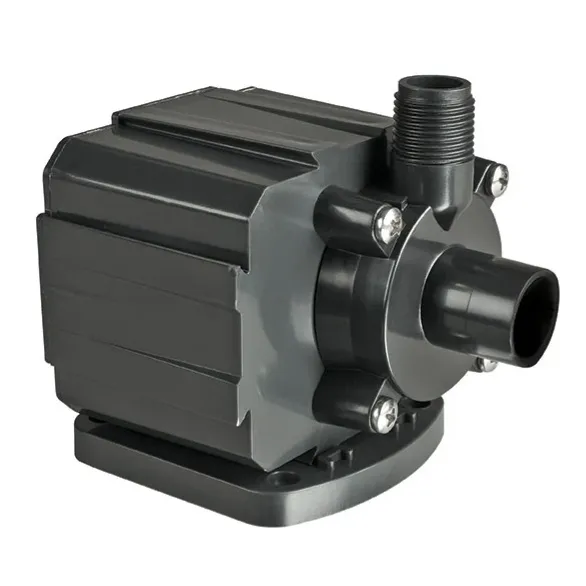
A submersible pump goes straight into the water and gets to work. No priming, no suction line, no vault to build. Drop it in, run the cord to a GFCI outlet on shore, and you have circulation in under half an hour. Because it's surrounded by water, it runs quietly — most of the sound stays underwater — and it's almost always the more affordable way to get a pond moving.
Magnetic drive models like the Pondmaster Pond-Mag Magnetic Drive pumps are a favourite for smaller ponds, fountains, and filtration loops — they sip electricity and shrug off mineral build-up. For a turnkey small fountain, the Pondmaster Eco Submersible Pump & Fountain Head Kit bundles the pump and spray heads together so you're not guessing at fittings.
External pumps are what you graduate to when your pond starts asking for more than a submersible comfortably gives. More volume, more head height, more debris, more hours per day — and you'd rather not wade in every time something needs a look.
An external pump lives on dry land, so servicing it is a clean, standing-up job — no rolling up your sleeves and fishing around the pond floor. Because the motor is air-cooled rather than water-cooled, it tends to run cooler over its life and last longer, and it doesn't add any heat to the pond water (a real plus on big koi systems where summer water temperature matters). Many external pumps are also remarkably energy-efficient at moving large volumes, which adds up fast when a pump runs around the clock for six or seven months.
The catch is everything that makes them powerful also makes them more demanding up front. You need a dry, accessible location below or near the waterline, proper suction and return plumbing, and on many designs you'll prime the pump before it'll move water. They typically cost more to buy, and the motor sitting in open air means they're audible — fine in a tucked-away vault, less ideal three feet from a patio. For genuinely high-flow and debris-heavy jobs, this is also the territory of solids-handling pumps; for big circulation needs, ask our team which setup fits your build.
An external pump's dry well or vault has to be built with drainage in mind. A vault that collects rainwater or pond seepage and then freezes around your pump in January is a classic Canadian mistake. Build the location so it sheds water and stays accessible even with snow on the ground — you'll thank yourself the first time something needs a mid-winter check.
When you strip away the marketing, the decision usually lands on four things: pond size, flow demand, how much you mind getting wet to do maintenance, and your budget. Here's the quick visual version.
| Factor | Submersible Pump | External Pump |
|---|---|---|
| Where it sits | Inside the pond, underwater | On dry land beside the pond |
| Install effort | Drop-in, under 30 minutes | Planned location + suction/return plumbing |
| Upfront cost | Lower | Higher |
| Noise | Very quiet (runs underwater) | Audible in open air |
| Servicing | Reach into the pond (wet job) | Dry-land access (clean job) |
| Typical lifespan | Shorter | Longer (cool, dry motor) |
| Heat into pond | Some (minor on small ponds) | None |
| Best pond size | Small to mid | Mid to large / high-flow |
| Priming required | No | Often yes |
Anywhere with mild winters, the submersible-versus-external question is mostly about preference and budget. In Canada, winter is a genuine decision-maker — because freezing water expands, and expanding water inside a pump cracks housings, splits seals, and turns a working pump into a planter. How you handle each type through the cold months is different, so let's be specific.
For most decorative ponds and water features, the standard move is simple: pull the submersible pump before freeze-up and store it indoors. Once water temperatures drop toward 10°C in the fall and the pond is heading for ice, lift the pump out, rinse it, and keep it somewhere above freezing for the season. A pump left running as the surface ices over can pull supercooled water around and create thin, dangerous ice — and a pump left switched off but still submerged can freeze into the ice and crack.
There's one important exception. If you keep fish, you generally do not want full water circulation in winter, because churning the water can chill the deep zone where fish are wintering. Instead of running the pump, fish-pond owners typically switch to aeration plus a de-icer to keep a gas-exchange hole open in the ice. That's a different system than your main pump — and worth reading up on separately.
An external pump isn't sitting in the pond, so it won't freeze into the ice — but it's holding water inside its housing and plumbing, and that water freezes just as happily. If you're shutting the system down for winter, you have to drain the pump and all the lines completely so there's no standing water left to expand. Open the drain plugs, clear the suction and return lines, and let it sit empty.
Some pond owners in milder parts of the country run external systems through winter to keep waterfalls flowing, but that only works if the water never stops moving — a power outage or a clog on a sub-zero night can freeze a "running" system fast. If you go that route, the location needs to be insulated and reliable, and you need a plan for what happens when the power blinks. For most people, draining and shutting down is the lower-risk choice.
Whether your pump sits in the pond or on the shore, the failure mode is identical — water that can't move freezes, expands, and cracks something. Submersibles get pulled and stored dry. Externals get drained and emptied. Fish ponds switch to aeration and a de-icer rather than full circulation. Follow whichever path matches your setup and you'll start every spring with the pump you finished fall with.
| Season | Submersible Pump | External Pump |
|---|---|---|
| Spring (Apr–May) | Clean, inspect the impeller, drop back in once ice is fully off | Re-seal plugs, prime, and start once freeze risk has passed |
| Summer (Jun–Aug) | Run continuously; rinse the intake screen as debris builds | Run continuously; check the strainer basket and plumbing seals |
| Fall (Sep–Oct) | Pull and store once water nears 10°C and ice is coming | Plan shutdown; confirm all drain points are accessible |
| Winter (Nov–Mar) | Store indoors above 0°C (fish ponds: switch to aeration + de-icer) | Drain pump and all lines fully, or insulate if running non-stop |
Here's the shortcut most of our customers land on after talking it through.
Your pond is small to mid-sized, you want a fountain or a modest waterfall, you'd rather not build plumbing and a vault, and a slightly shorter pump lifespan is an easy trade for a much lower price and a five-minute install. This is the right answer for the overwhelming majority of Canadian backyard ponds and water gardens.
Your pond is large, you're feeding a tall waterfall or a koi system, the pump runs long hours every day, and you want easy dry-land servicing plus the longest possible service life. You're willing to invest more up front and plan the plumbing properly in exchange for efficiency and durability at high flow. If that's you, talk to our team about the right high-flow setup before you buy — sizing matters more here than anywhere else.
If you're hovering right on the line — say a mid-sized pond with a fish load and a decent waterfall — tell us your pond volume, your waterfall height, and how many hours a day you'll run it. Those three numbers settle the debate faster than any chart, and they're exactly what we ask when we help size a pump.
Browse magnetic drive, high-flow, and solids-handling submersible pumps — or talk to our team about sizing the perfect setup for your pond. Canada-wide shipping and expert support included.

1/2, 3/4, or 1 HP? Kasco's official sizing chart translated for Canadian winters — open-water coverage by model, mounting angle, and region.

De-icers aim open water at docks and lifts; bubblers (diffused air) suit deep ponds and dugouts; aerators are summer tools. Here's how to choose fo...
Buying too small is the number one mistake we see. Tell us your surface acreage and depth and we will spec the right unit before you spend a dollar.


Genuine units with full manufacturer warranty, not grey-market imports.
Factory-trained bench techs rebuilding motors, seals and props in Markham.
We have installed and serviced these systems since 1967.
Most orders leave the warehouse in 1-2 business days.
Shutdown, storage and de-icing guidance every freeze-up.
Call and reach someone who has installed this equipment.